Yu Sheng: The Most Iconic Chinese New Year Ritual in Malaysia
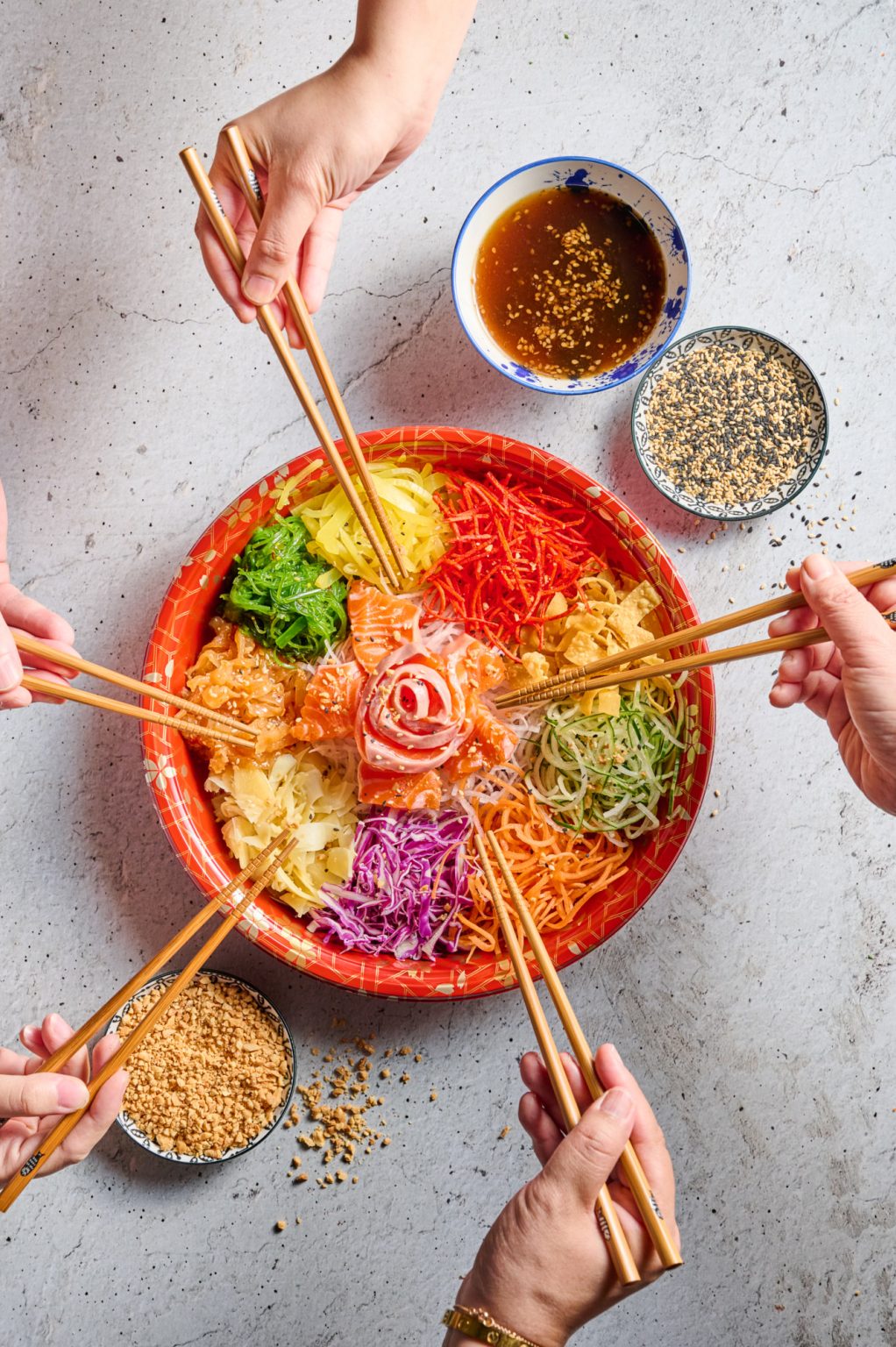
Yu Sheng or Yee Sang, alternatively known as Lao Sheng or Lo Hei, is one of the most recognizable Chinese New Year rituals in Malaysia (and Singapore). Served as a vibrant raw fish salad and tossed high into the air with shouted blessings, it marks not just the start of a meal but the symbolic rise of fortune for the year ahead. At first glance, it looks like a colourful platter of shredded vegetables and fish. But every ingredient, every word spoken over it, and every upward flick of chopsticks carries layers of mythology, migration and meaning.
The name Yu Sheng/Yee Sang 鱼生 literally means ‘raw fish’. In Chinese prununciation, ‘fish’ (鱼) sounds identical to ‘surplus’ (余). So when families say ‘nian nian you yu’ (年年有余), they are wishing for abundance year after year. In Cantonese, Lo Hei (捞起) means to toss up, also implies rising or elevating. Language itself becomes part of the blessing.
The ritual is closely linked to Renri (人日), the seventh day of the Chinese New Year. According to Chinese legend, the goddess Nu Wa created animals over six days and formed humanity on the seventh. That day became known as the Day of Humankind. Traditionally, seven symbolic ingredients were eaten to mark this occasion. In Southeast Asia, that evolved into the elaborate Yu Sheng platter we know today.
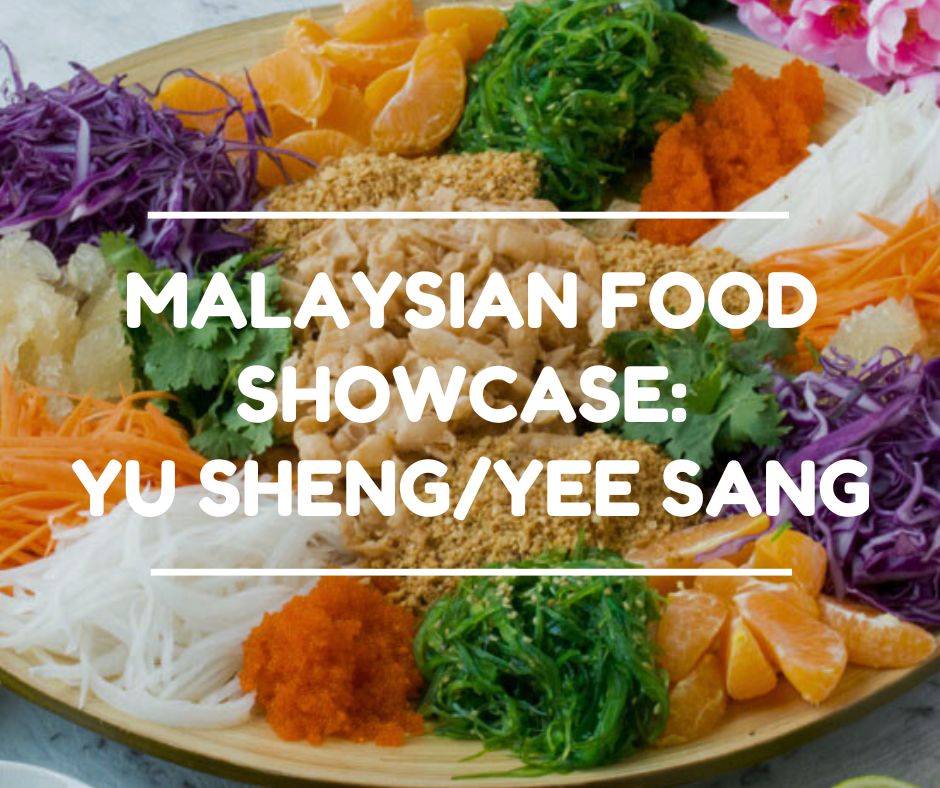
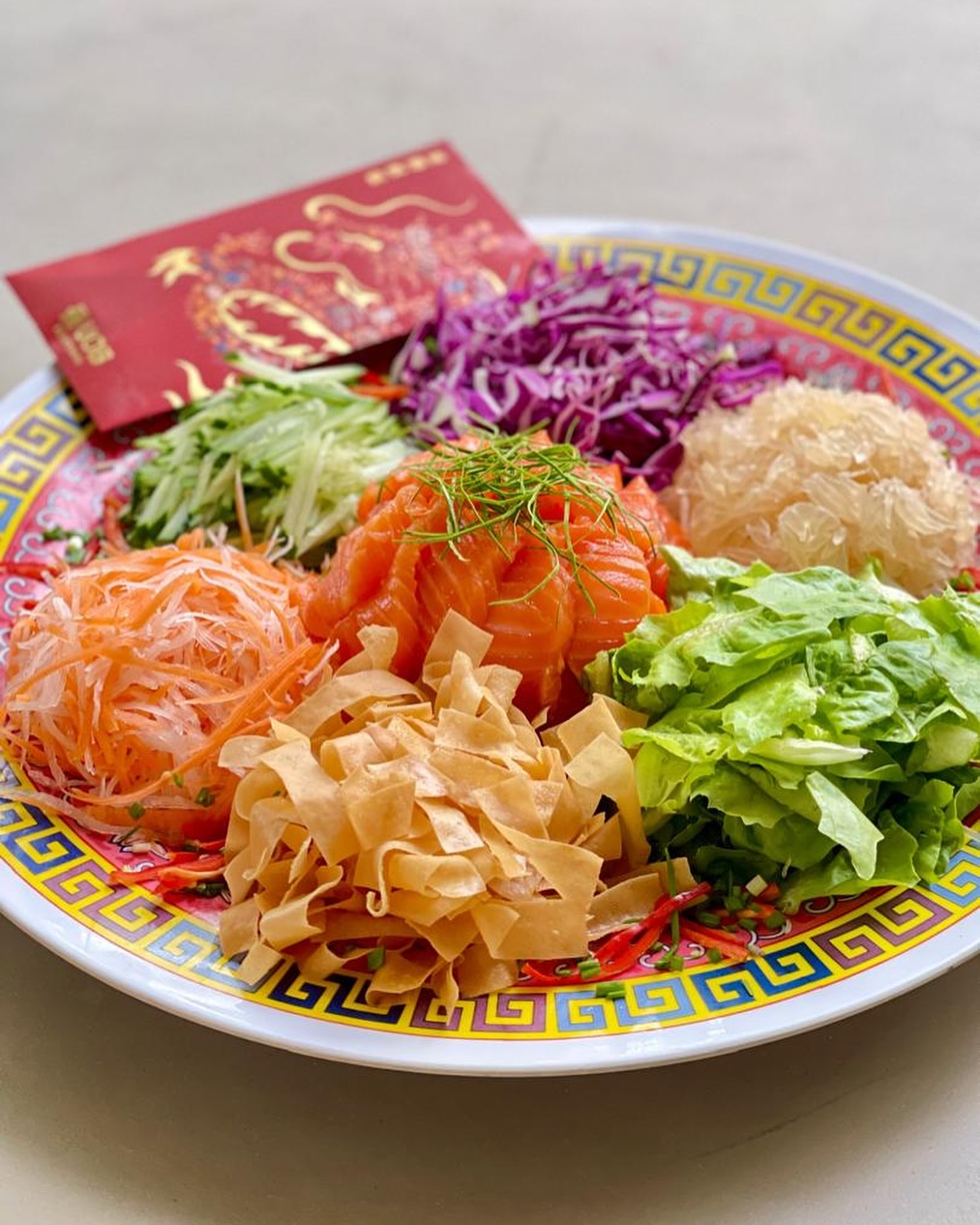
The preparation begins with a large round plate placed at the center of the table. Thin slices of raw fish are laid down first. Historically this may have been wolf herring or grass carp in earlier Chinese traditions, but today salmon is the most common. Around the fish, neat piles of shredded white daikon, carrot, pickled ginger, pomelo sacs, capsicum, coriander and sometimes jellyfish form a bright spectrum of color. Some modern versions boast up to 27 ingredients.
Condiments are added ceremonially. Crushed peanuts symbolize gold and silver filling the house. Sesame seeds represent flourishing business. Pepper is sprinkled to attract wealth. Oil is poured in a circular motion to invite prosperity from all directions. The plum sauce dressing, often made with plum paste, rice vinegar and sesame oil, is drizzled generously, symbolizing sweetness in life.
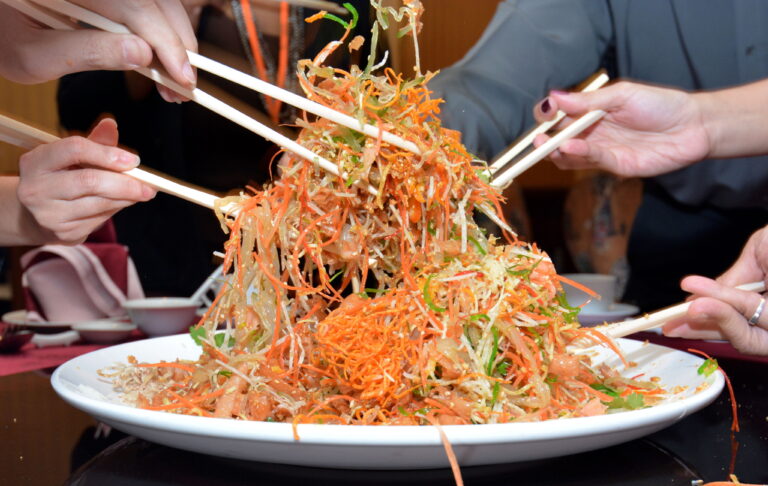
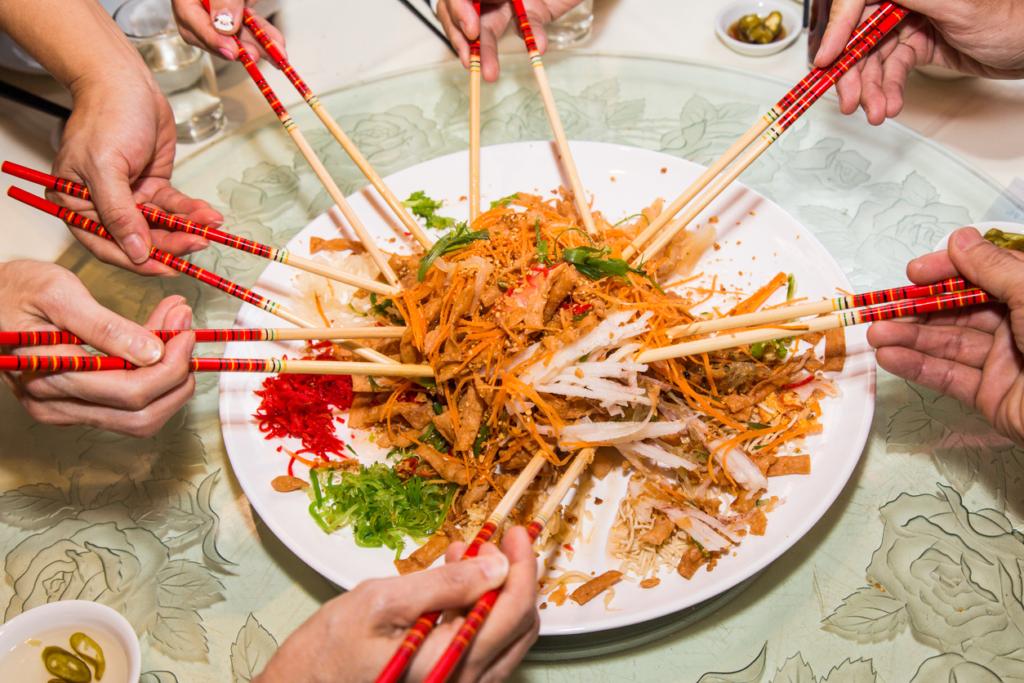
Then comes the crescendo. Everyone stands. Chopsticks dive in. Auspicious phrases fly across the table. ‘Gong Xi Fa Cai!’, ‘Wan Shi Ru Yi!’, ‘Lo Hei!’ The salad is tossed high into the air. The higher the toss, the higher the fortunes are believed to rise. It is noisy. It is chaotic. It is joyful. And that chaos is intentional. Prosperity is not meant to be quiet.
While raw fish consumption can be traced back to ancient China, with references as early as the Zhou dynasty to finely sliced fish known as ‘kuai’ (脍) the modern prosperity toss ritual is largely a Southeast Asian creation. Chinese immigrants arriving in Malaya and Singapore in the early 20th century brought with them traditions of eating raw fish during the New Year. But it was only about 70 to 80 years ago that chefs in Malaysia and Singapore began standardizing the colourful prosperity platter called seven-coloured Yu Sheng “七彩鱼生”.
In Malaysia, especially in Seremban, Loke Ching Fatt’s restaurant in the 1940s is often cited as one of the earliest commercial sellers of Yu Sheng. Meanwhile, Teochew associations argue that the practice of eating raw fish on Renri dates back to Qing dynasty customs, and that Teochew migrants brought the tradition to Malaya. Some claim the dish evolved from earlier fish noodle dishes served during Renri in Negeri Sembilan. In Singapore, four chefs in the 1960s are credited with refining and popularizing the modern presentation, including the now-iconic pre-mixed plum sauce introduced in the 1970s. Both countries share overlapping migration histories, and debates over ownership continue to surface from time to time. Yet many now agree that the dish belongs to the broader Nanyang Chinese experience rather than a singular event.
Interestingly, while raw fish dishes exist across China and East Asia, the prosperity toss ritual as practiced today is mostly unique to Malaysia and Singapore. It is not widely observed in mainland China in this form. Here, it became something bigger. A communal performance. A cultural marker. Better yet, in 2009, Malaysia’s Department of National Heritage recognized Yu Sheng as an Intangible Heritage Object.
Over time, variations multiplied. Some Malaysian versions are described as more balanced and less sweet. Some renditions lean towards sweeter taste. Premium versions include abalone or smoked salmon. Vegetarian adaptations replace fish with soy-based alternatives. Fruit-forward platters now feature pear, guava, apple or dragon fruit for added freshness. Pre-packed Yu Sheng kits are sold in supermarkets during Chinese New Year, ready to be assembled at home.
Despite these modern conveniences, the heart of the ritual remains unchanged. It is usually served as the appetizer during reunion dinners anytime between the first and fifteenth day of the Chinese New Year, though traditionally associated with Renri. Families gather. Colleagues celebrate in offices. Restaurants fill with the sound of collective shouting and laughter.
If you ever find yourself around a Yu Sheng platter, do not be shy. Toss with intention. Let the shredded radish fly. Say the blessings out loud even if your pronunciation is imperfect. Because Yu Sheng is not about neatness. It is about shared optimism. It carries ancient echoes of raw fish feasts, southern Chinese migration, Cantonese wordplay, Teochew Renri customs, and Nanyang reinvention. It is history, myth and modern commerce all layered together, served on one round platter.